J.L. Chua on Writing Violence to Mirror Society’s Truth
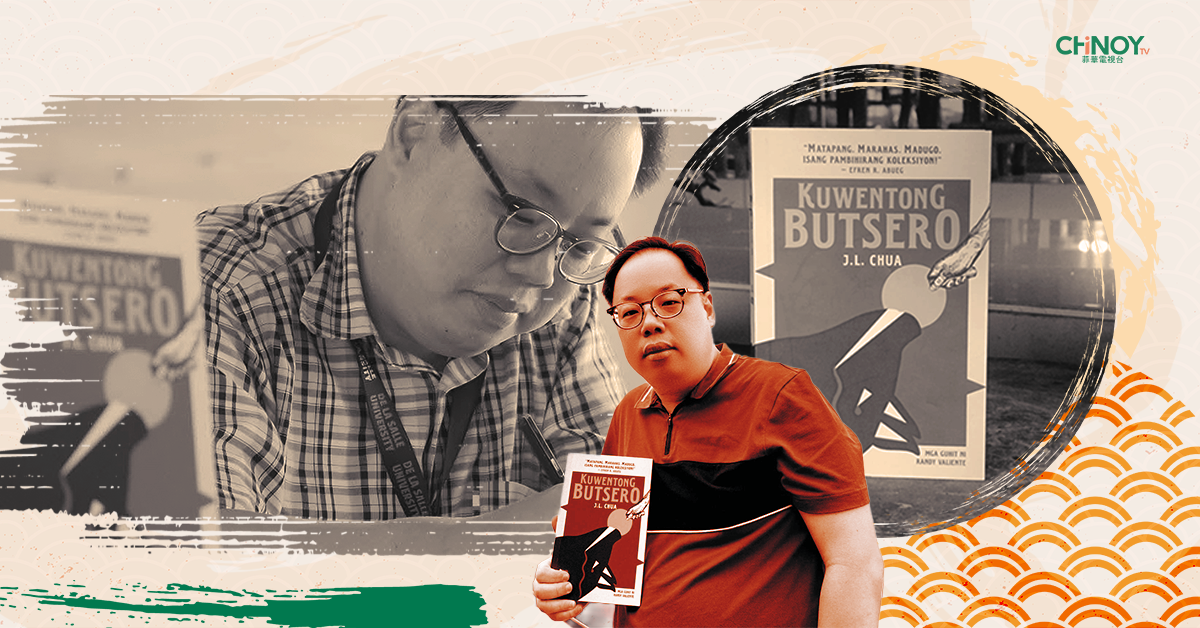
Kuwentong Butsero: Confronting the Uncomfortable Realities
People grow up with many versions of who they want to be, but for J.L. Chua, writing is not just a choice; rather, he sees being a writer as the only path on the road of life.
With a strong drive to tell stories, his narratives emerged from his inner soul. The way he yearns to go beyond his comfort zone allows him to view the world as being marked with oppression, violence, and inequality.
These central themes drove him further to use his voice to reflect the horrors of our society and to write violence to confront the uncomfortable realities we often overlook and dismiss through the book Kuwentong Butsero.
The Early Years of His Writing Journey
Childhood is the time when we discover the things we are passionate about, and our innocent minds will someday carry this into adulthood.
This statement reflects Chua’s love for writing. He shared, “Writing a book was my childhood dream. I wanted to walk into a bookstore and see my book on a shelf. It may not be the most lucrative career, but it is fulfilling for my soul.”
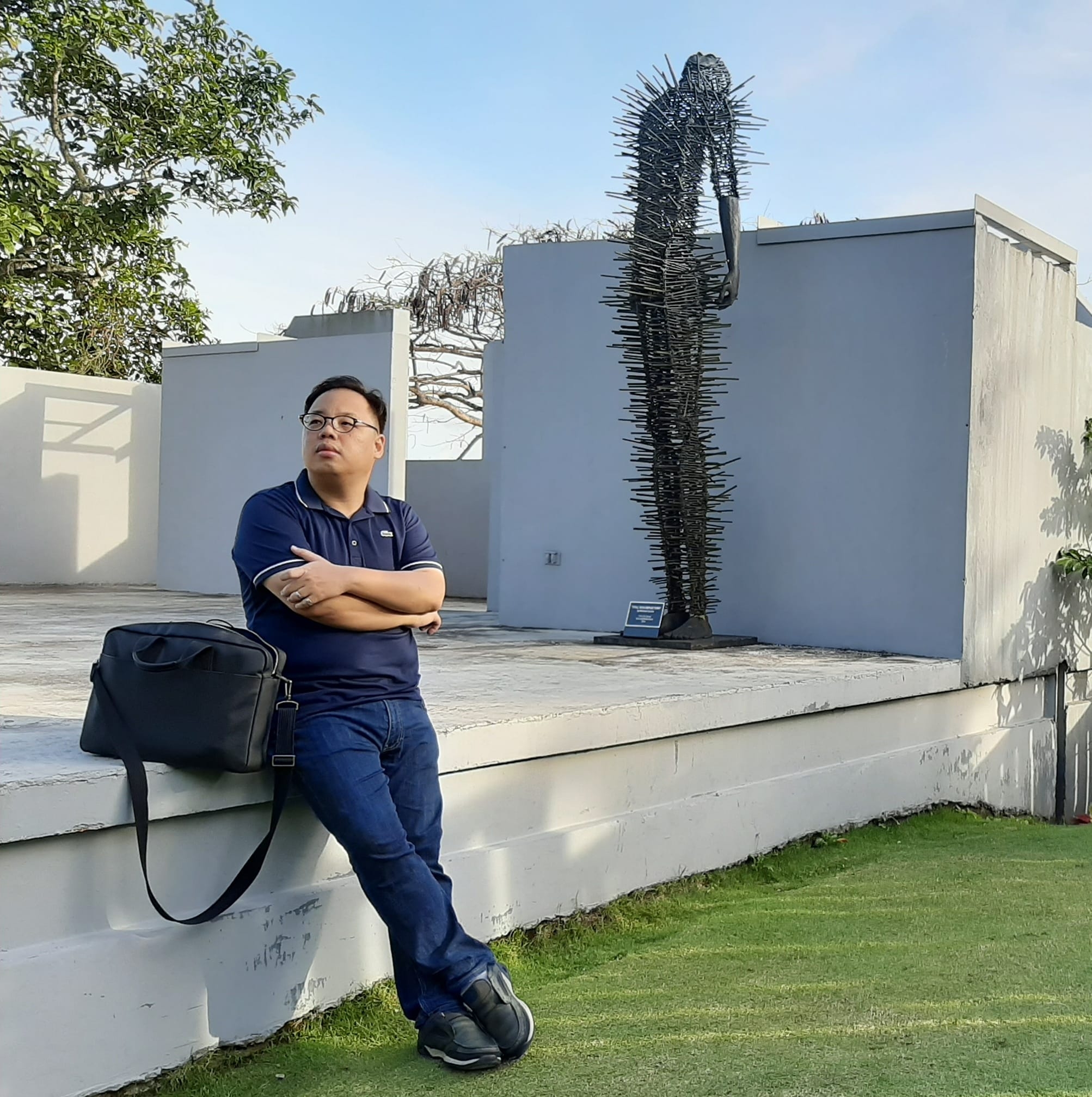
(Photo from J.L. Chua)
Chua’s love for words is like a wave hitting a shore. It was nurturing and calming—and the ripple effect of this was even greater when he read a short story by Efren R. Abueg.
“A consequential moment happened in my third year of high school at Grace Christian when I came across a short story, Mapanglaw ang Mukha ng Buwan, by the eminent Filipino fictionist Efren R. Abueg. Our Filipino textbook was largely ignored in a school that prioritized Science and Math, but that story captivated me. I was riveted. It awakened something in me. I knew then that I wanted to become a writer like Abueg,” he recounted.
In this memory, Chua has shown that he saw the world through a different lens, especially as a third-generation Filipino-Chinese. He stood above cultural expectations and still chose a path close to his heart. And even if unconventional, he still firmly believes in ars longa, vita brevis: “art is long, life is short.”
Due to the influence of Abueg, he remembered, “Growing up, I saw the world differently, much to my parents’ concern. Many assume that privilege creates a bubble, shielding one from the struggles of others. But I had an “alter” (not the sex ha!) who gravitated toward the streets—attending protests, listening to the stories of the disenfranchised, eating/ drinking with the oppressed, and immersing myself in realities beyond my own. These experiences shaped my writing and influenced my characters.”
Bringing these ideals, his early love for writing turned into professional training. He became part of the literary folio of De La Salle University called Malate while earning a degree in Economics. He also pursued a Master’s in Creative Writing that further sharpened his literary skills. He also practiced as a journalist at the Manila Bulletin for 25 years.
And for this, he had the perfect formula to write Kuwentong Butsero.
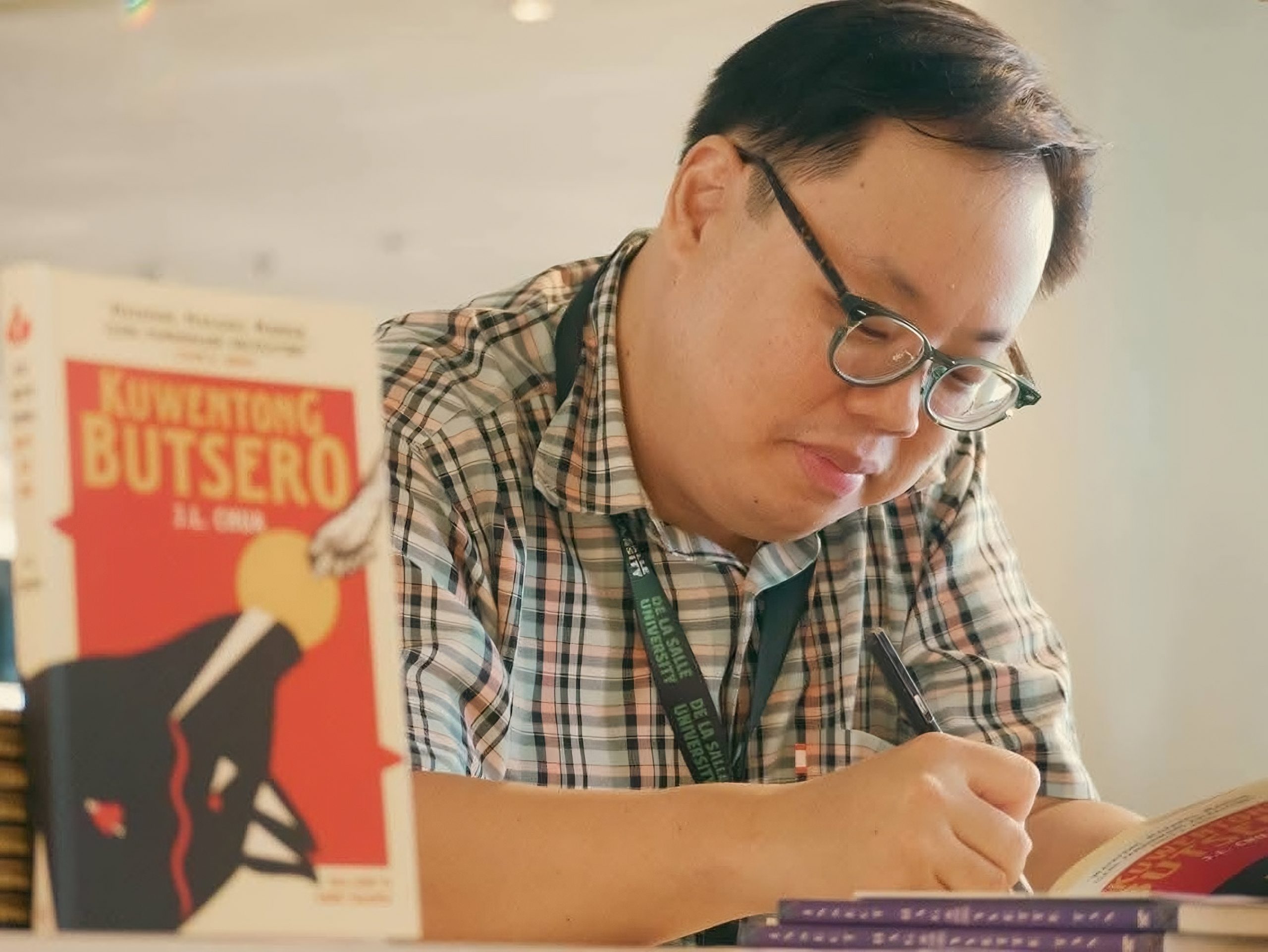
(JL Chua signing his book | Photo by Billy Ibarra)
The Writing of ‘Kuwentong Butsero’
When reading Kuwentong Butsero, one might feel “nauseous” due to the graphic details it contains. The brutality toward the characters was never censored. Chua was unrestrained, and as his mind speaks, his pen continues to write with frankness.
He did not shy away from the grim realities because of his experience. “In my 25 years in journalism, I wrote hundreds of articles and handled various sections, from health, travel, home, and design to property and environment. I also served as editor of Liwayway magazine. Through all of this, I met countless people, visited many places, and gained a deeper understanding of both the good and ugly aspects of life.”
Exposed to all of it, he wrote Kuwentong Butsero with a stronger grasp of humanity’s darkest secrets: pride, greed, lust, envy, gluttony, wrath, and sloth. Each chapter of his book shows how these sins are transformed into violence.
He continued, “We live in turbulent—and often violent—times. The violence may not always be literal or bloody, or on the battlefield, but it exists in other forms: inequality, discrimination, abuse of power, exploitation. These are everyday violences that often go unnoticed, sometimes even by those who inflict them.”
To properly show the violent theme, he used the butcher as the central idea.
He explained, “As for the ‘butchers’ aspect, the inspiration came during one of my visits to the old Arranque Market. I was fascinated by the energy, the grit, the texture of the place. It took several trips, research, and close observation to really capture the mood of that setting. So I’m especially proud of how the story Katay (which is the updated title of the original Kuwentong Butsero) turned out. You can feel, hear, smell, and see the market come alive on the page.”
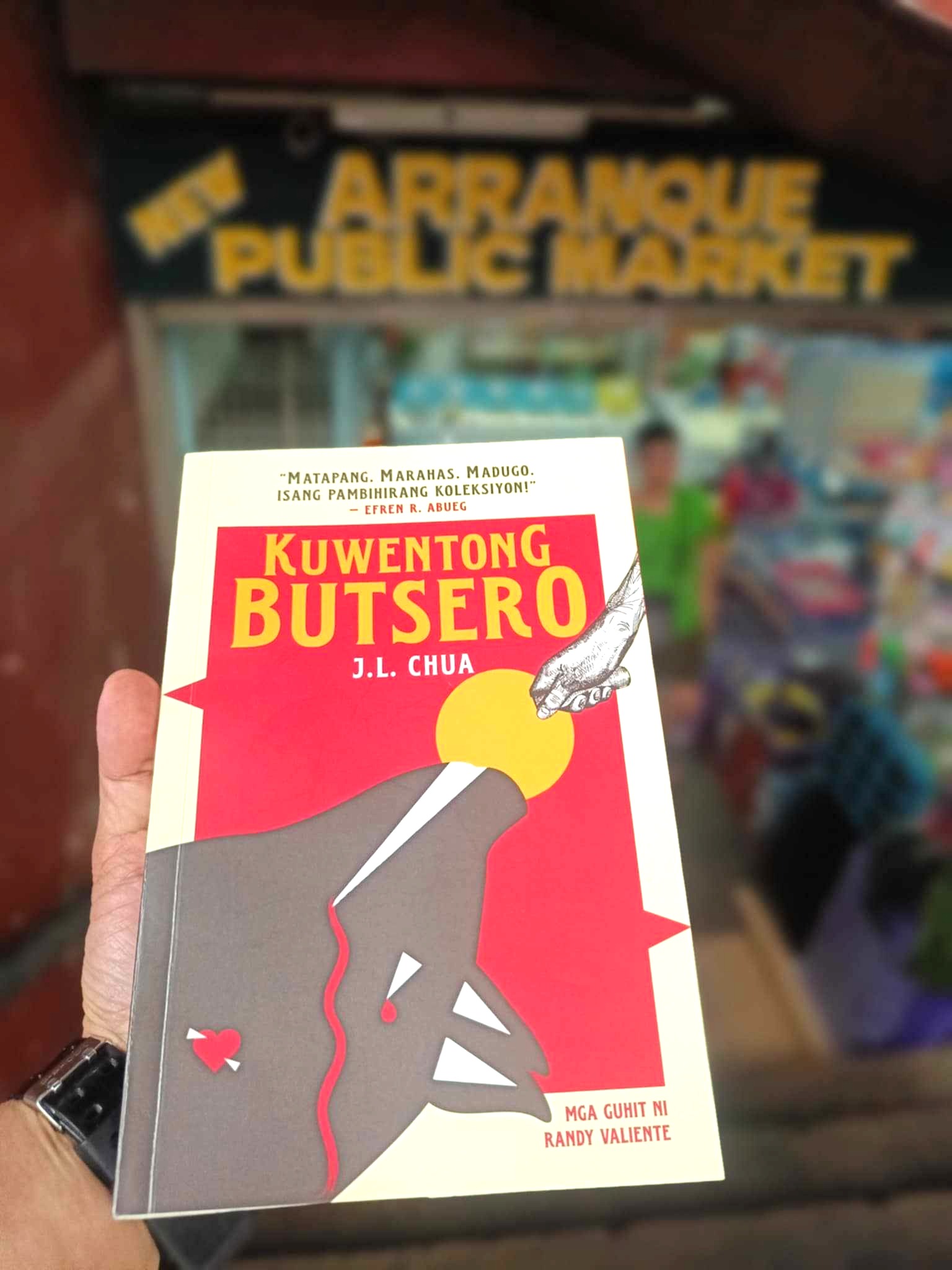
(Kuwentong Butsero in Arranque Public Market | Photo by JL Chua)
True to his words, reading the book chapter by chapter makes you realize that the world is indeed cruel: characters who are abusive in the workplace, discriminatory, bullies, and capable of other harsh acts. He captures the suffering of the oppressed, even through dishes like Manang Eta’s crispy pata and dinuguan as symbols in his story.
“Although not intentional, both dishes came to symbolize violence because of the way their raw ingredients are obtained. Consider the pig, a sentient creature capable of feeling, being slaughtered for food. The act itself mirrors the brutality and suffering inherent in human society, reflecting the cycles of violence we inflict on others, both animal and human.”
Life is full of sufferings, whether it be inflicted by others or by yourself. The book greatly captures how a person can be broken by an exploitative system that may reach a point of no return.
“When a friend once asked me what the book is about, I said it is a collection filled with characters who kill and are killed, who oppress and are oppressed—people who defy the established structures of society not out of desire, but because it has become their last resort to survive. At that point, they no longer care about what others will say, the consequences of their actions, or the punishment that awaits them. In their minds and in their entire being, their decisions feel justified, even if carried out through violent and bloody means.”
We all have our own rubicon. The difference lies in how—and when—we cross it. Is it when someone violates you? When something is taken from you? Or when survival itself demands a choice in the face of violence? As the writer Alfred Henry Lewis once said, “There are only nine meals between mankind and anarchy.”
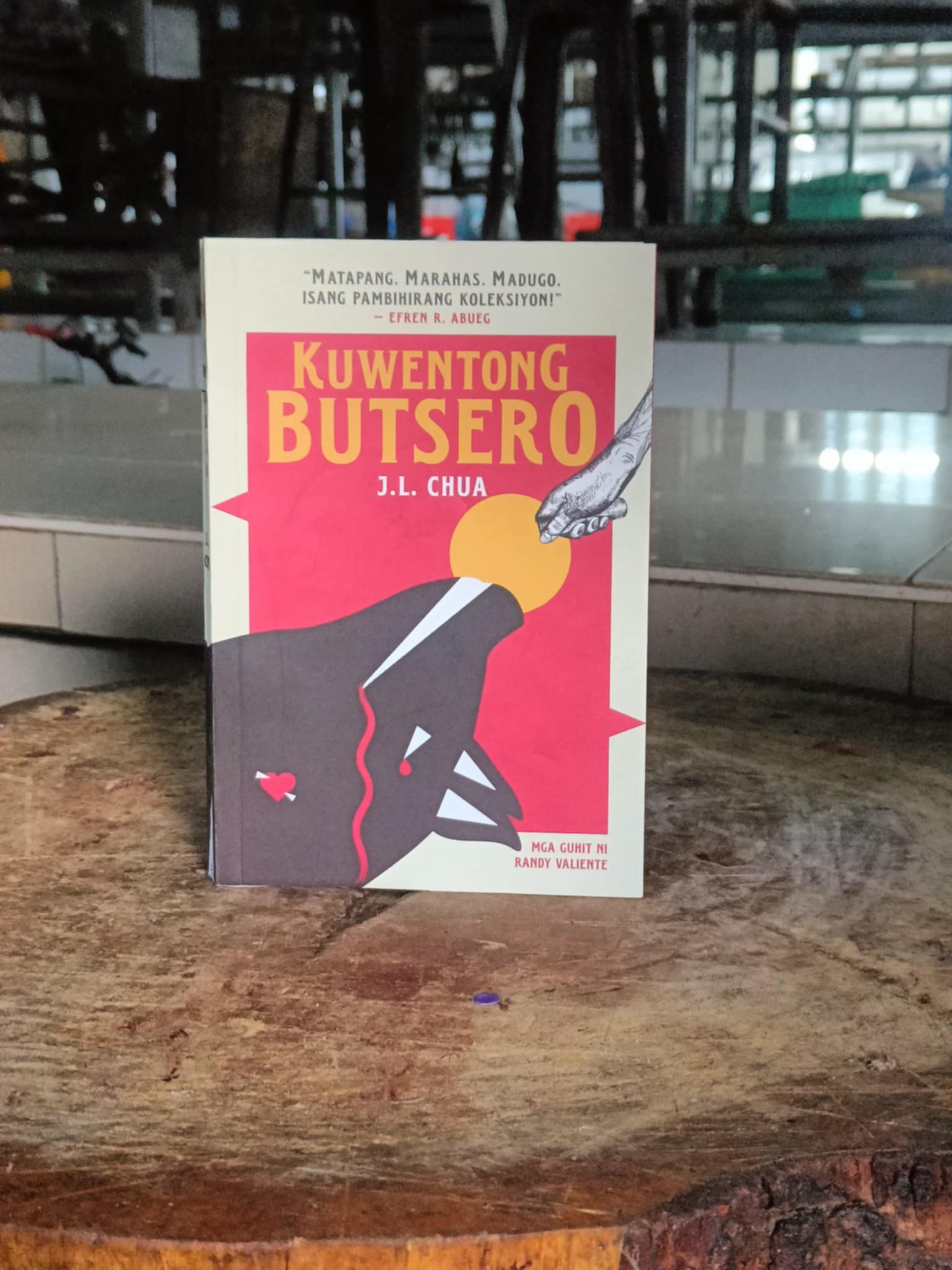
(Photo by JL Chua)
Why it is Important to Write for the Oppressed
The original Kuwentong Butsero was a short story Chua wrote during his freshman year at DLSU. In 1999, it won 2nd prize at the 15th DLSU Literary Awards. Later, he submitted it to the Gawad Ka Amado V. Hernandez, where it won 3rd prize.
He recounted, “I still vividly remember the awards night held at the Iglesia Filipina Cathedral, where I met one of the judges—the bold and brave writer, the late Ave Perez Jacob. He gave me a copy of his book Lagablab sa Utak ni Damian Rosa and left me with a powerful note: ‘Magsulat para may boses ang mga api!’ (Write so that the oppressed will have a voice).”
To this day, Chua still considers that book (and that message) part of his creative foundation and inspiration. He also realized that writing has to be authentic. It has to come from your innermost soul.
My stories reflect a reality where horror lies not just in the supernatural, but in how we live, how we treat one another, and how systems fail the vulnerable (ang mga api).
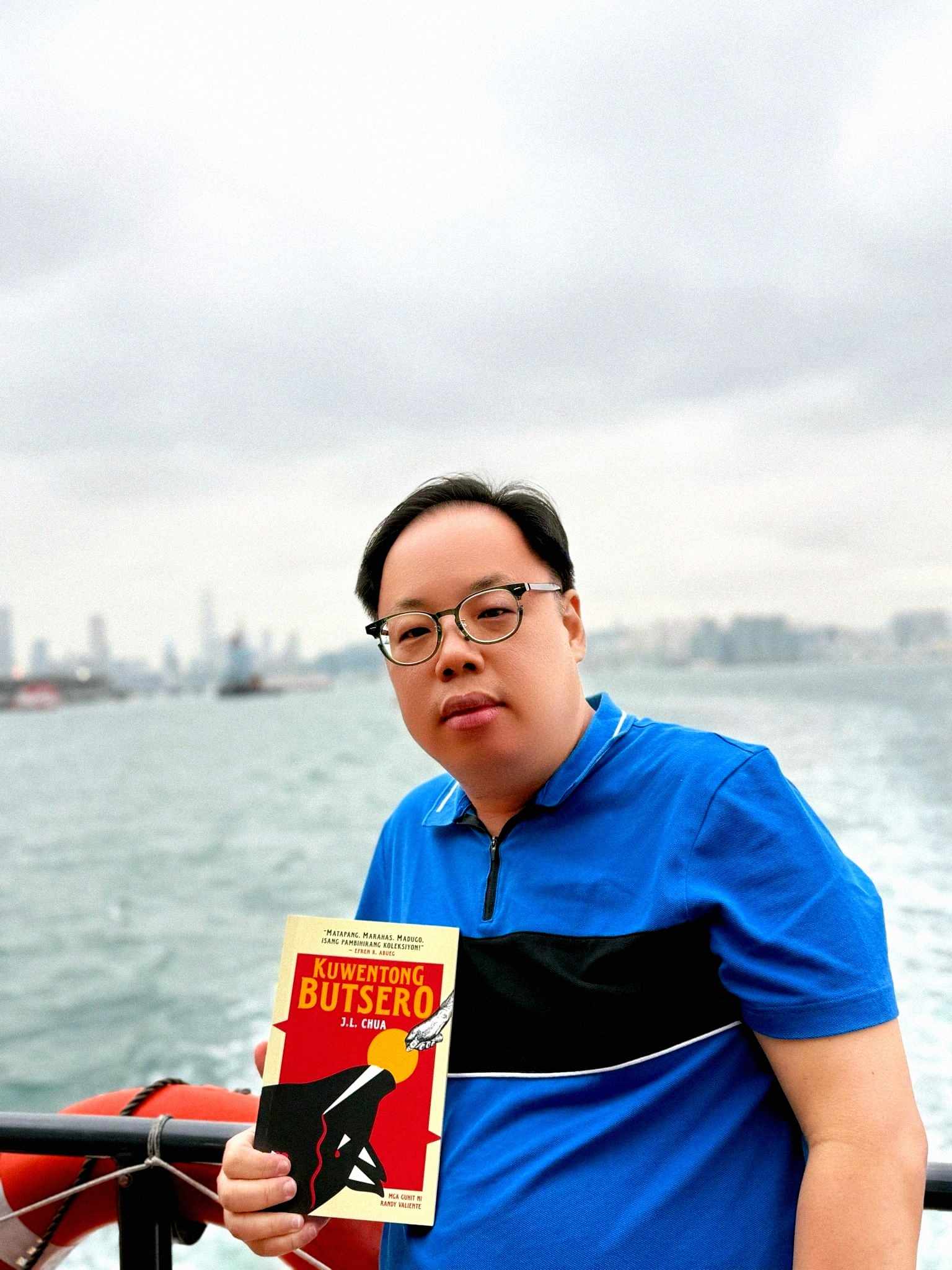
(Photo by JL Chua)
He added, “It can be dangerous to tell writers that their work must prioritize addressing injustices. Writing should first and foremost be authentic. When it is true to the writer, whatever message it carries—whether political, social, or purely imaginative—will naturally find its place.”
Carrying the ideals of the late Jacob, Chua became a transgressive fiction writer. It is a genre that focuses on characters who feel confined by social norms and rebel against them through unconventional ways.
“To write transgressive fiction is to explore the extremes of behavior and emotion—the violence, the contradictions, the impulses we try to suppress. It is not about glorifying darkness, but about interrogating it: asking why it exists, where it comes from, and what it reveals about us as a society.”
Chua is confident in continuing to write about these truths, not because they are marketable, but because they are there and they demand to be told.
He revealed, “Kuwentong Butsero is the first installment of a pentalogy I call Kuwentong ABKDE. The next book, Kuwentong Astronomo (the “A” part), will feature transgressive futuristic stories. Then there’s Kuwentong Kuneho, a collection of transgressive erotica.”
Chua is also working on the first Filipino novel on cannibalism, which will be controversial. He plans to write a “fun,” quirky English novel inspired by Crazy Rich Asians, centered this time on the Chinoys.
About the Author